

Asylum Interviews in Southern Italy: Narratives, Credibility and Consequences

Interviews between asylum seekers and territorial commissioners are an essential part of the asylum application process in Italy and many other European countries. In most cases, decisions are based mainly on what applicants say during these interviews, rather than on documentary evidence. As a result, asylum authorities evaluate whether the asylum seeker’s story appears consistent and credible before deciding whether to grant refugee status or another form of protection.
The analysis of the interviews conducted before the Neapolitan Territorial Commission offers a clearer understanding of the inherent challenges that one can expect during this process. Emphasizing the specific effort required to produce a narrative that is both legally credible within the institutional framework, and humanly and culturally appropriate from the applicant’s point of view.
This is particularly challenging as most asylum applicants’ journeys to safety are not always linear and are often shaped by intense violence, abuse and trauma, all of which can potentially impact a person’s ability to provide a clear and detailed narrative that meets legal expectations. Understanding how these narratives are constructed is therefore important to navigate the tension between legal norms and the need to protect the integrity of the asylum seeker’s case.
Three Different Stories with Different Outcomes
The tension between the need to tell the “right story” – the one defined by the legal framework and expected by asylum officers – and the desire to be recognized as a full person with a specific cultural and social background becomes particularly visible for individuals who have experienced discrimination, exclusion, and trauma. This is illustrated by the cases of Alejandro, Mohammed, and Sharmin, who arrived in Italy from El Salvador, Pakistan, and Bangladesh.
Alejandro fled political violence and gang extortion. During the interview, he was able to give a detailed and structured account of the threats he faced, the risks he would face if returned, and his current life in Italy:
“They came to my brother to demand the ‘renta’ [exploitative form of payment], which was normal for us. There’s a password every merchant has that the gang gives. After two days, the head of the organization called again, asking us to pay again. We told them we had already paid and even gave them the password. He said, ‘Okay, I’ll talk to the guy,’ but that guy denied everything. So, we had to pay the extortion again because we were afraid something might happen […].”
In this first part of Alejandro’s free narrative (part of the interview), he provides a clear and detailed description of a practice that seems to be part of daily life in his community. Alejandro seems to have violated this norm due to a misunderstanding, which had an impact on the community (police attention) and placed his personal safety at risk. His narrative was consistent and aligned with available information about conditions in his country of origin. On this basis, the asylum commission considered his story credible and granted him refugee status (under the 1951 Geneva Convention).
Mohammed fled after his Shia girlfriend was killed in an honor-related family conflict: “The problem is that her family is Shia, and there is bad blood between Shias and Sunnis […]. My girlfriend was shot by her brother because what was happening was considered dishonorable […].”
During his interview, his account was fragmented and difficult to follow, with missing details and inconsistencies that raised doubts for the commission. As a result, his asylum claim was rejected. However, his vulnerability and level of integration in Italy were recognized, and he was granted a form of special protection. This case shows how a deeply personal story can fail to meet the legal expectations of credibility.
Sharmin fled political tensions related to his work with a local mayor:
“I worked for the mayor of a village near ours. Before me, my father also worked for the mayor, but he couldn’t continue due to illness, so my mother and I went to work instead. However, it was election time, and the mayor was having problems with his opponent, and they had an argument.
One evening, two or three days before the election, the opposing candidate of my employer arrived armed with other people and attacked the mayor’s house. I was there, and I intervened—they were assaulting the mayor, and they were armed, and I was injured as well. I was in the hospital, but the mayor paid for everything. However, the argument with his opponent continued.
One day, the mayor told me not to work for him anymore because I wasn’t part of the family, and I shouldn’t take on problems that weren’t mine. He told me to leave and helped me arrange my trip to Libya, where I stayed for two years and worked.”
Sharmin’s narrative was considered too vague and insufficiently detailed to meet credibility requirements. As a result, the commission rejected his asylum claim.
Despite their different outcomes, the three asylum narratives follow a similar storyline. Each begins with an increasingly intolerable situation, followed by threats that escalate until a decisive moment forces a person to leave. Family and social relations often play an important role in triggering that turning point: “When I went to Quetta, after a day and a half on the bus, my friend’s aunt came to pick me up at the stop” (Mohammed).
What ultimately sets these cases apart is not the presence of risk, but how fully the story is told. Alejandro’s detailed and contextualized story was considered credible and led to protection, while Mohammed’s and Sharmin’s less specific accounts raised doubts, highlighting how the level of narrative detail can influence asylum outcomes.
Supporting Asylum Seekers More Effectively
These stories demonstrate how asylum narratives carry both legal weight and personal meaning. Alejandro’s detailed and culturally cohesive account satisfied both criteria, whereas Mohammed and Sharmin’s unclear and contradictory accounts were dismissed. The distinction is not just in what they had experienced, but also in how their experiences were articulated and understood within the asylum application process.
Attorneys and researchers should look beyond legal rules alone and adopt an interdisciplinary approach that combines the social and legal elements needed in asylum cases. This can help ensure that applicants have equal access to justice and challenge the rigid “credibility tests,” changing the focus toward understanding people’s experiences rather than excluding those who are already marginalized.
For people working with asylum seekers, paying attention to how stories are told helps make sense of the complexity of the asylum request. Looking beyond legal rules alone allows for a deeper understanding. Lawyers, social workers, and clinical-legal scholars can support a gradual transition from personal storytelling to legal reasoning, helping bring out important details that may otherwise be missed in a strictly legal reading.
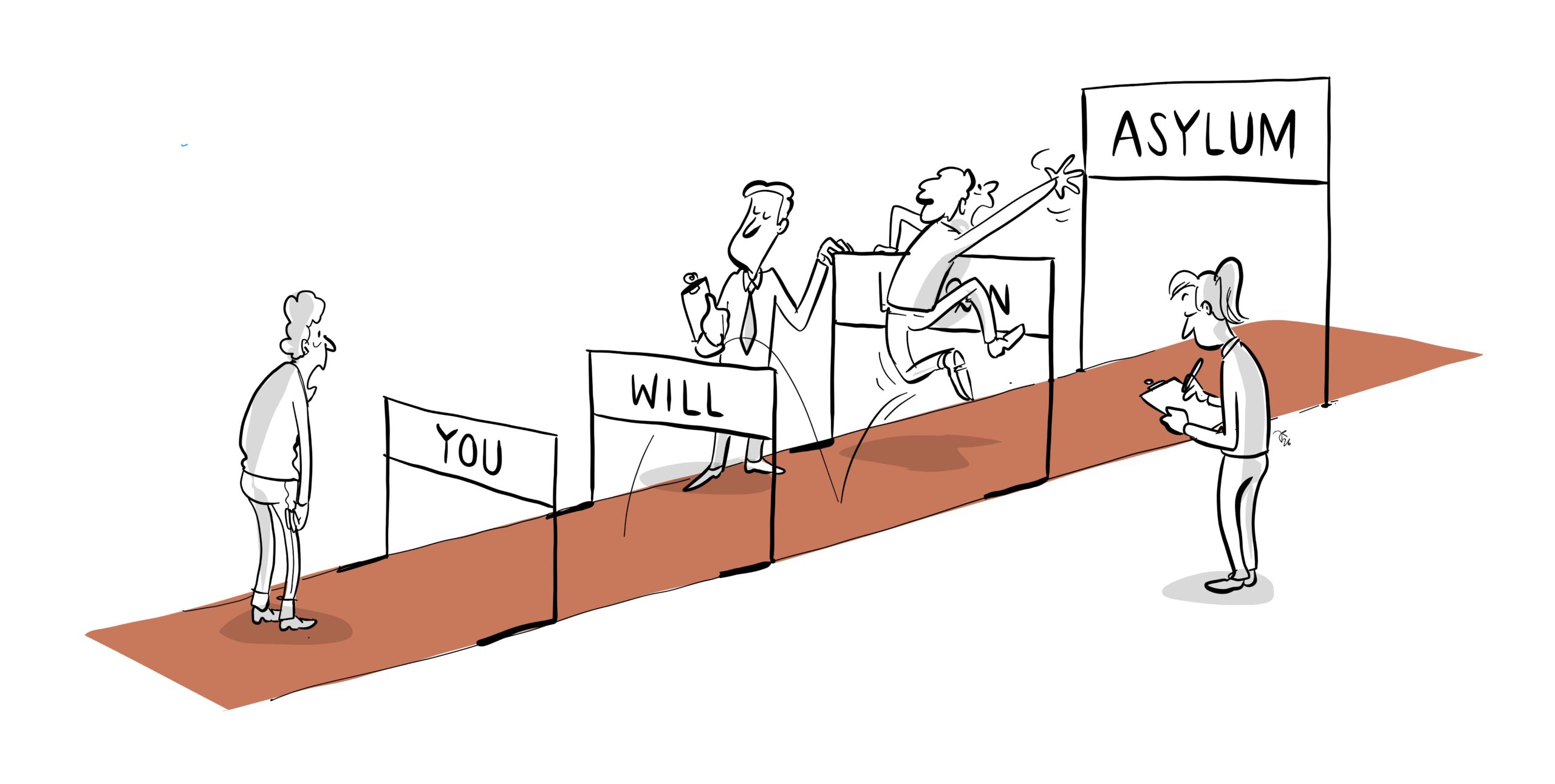
Illustration by Jonas Raeber
Flora Di Donato is a full professor of Philosophy of Law and Clinical Legal Training at the University of Naples Federico II, where she leads the Legal Clinics for Asylum Seekers and Stateless Persons.
References:
This post draws on F. Di Donato (ed.), Accesso alle audizioni nella procedura per il riconoscimento della protezione internazionale, Naples, 2024.
–Di Donato, C, Daiute. Coerenza e credibilità nei racconti dei richiedenti asilo: analisi, lacune e soluzioni collaborative. Ragion Pratica. 1, 2023. 7-29.
–Daiute, F. Di Donato. Tensions between Norms of Everyday Narrating and Legal Narrating. International Journal of Law in Context (Cambridge University Press). 1–20.
