

“Who Deserves Support?”: Immigrant Access to Social Rights During COVID-19

Social policy and immigration policy are among the most contested areas in contemporary politics, especially in the Global North. At their intersection – where immigrants’ access to welfare is decided – debates intensify. Here, questions of belonging and solidarity collide, with tangible consequences. They determine who receives support in times of need and who is left without a safety net.
Access to social assistance helps reduce poverty, supports social participation, and redistributes inequality across society. Yet people without citizenship are often excluded from this support. Comparative research across 46 countries shows a clear pattern: people without citizenship face restrictions or are excluded altogether from social assistance.
Civil society organizations (CSOs) play an important role in challenging these exclusions. They provide direct assistance where the state withdraws and mobilize politically to press for change. At the same time, they operate in a highly constrained public debate. Public opinion research shows that migrants are viewed as the “least deserving” (van Oorschot 2006) of benefits, and narratives of “benefit tourism” (Demetriou 2023) dominate political debate.
These patterns collided with the COVID-19 pandemic. Because of immigrants’ structural position – being overrepresented in precarious jobs and excluded from welfare – many were among the first to lose work while also being denied assistance. What emerged was not simply a health emergency, but a “crisis within a crisis” for non-citizens and for those advocating on their behalf. How did civil society organizations use the pandemic to advocate for immigrant social rights, and what tensions emerged from the narratives they adopted?
Research Context
These insights are drawn from in-depth research conducted in Switzerland and the UK. Based on interviews with civil society representatives and analysis of campaign materials, this study explores how advocacy strategies adapt in restrictive policy environments. In the UK, the No Recourse to Public Funds (NRPF) policy bars many immigrants from social assistance. In Switzerland, applying for benefits can put residence permits at risk, discouraging also those in severe hardship from seeking help.
During, and partly in response to, the pandemic, several campaigns against these exclusions were launched. Civil society organizations did not succeed in abolishing the policies altogether, but they did achieve tangible improvements. In the UK, free school meals were extended to all children, regardless of status.
In Switzerland, exemptions were initially announced for people who had lived in the country for more than a decade – a “historic success” that, as interviewees noted, was made possible by the political oxygen of the pandemic (see Poverty is not a Crime). However, the campaign’s success now again appears to have been compromised by the current political majorities.
Narratives under Constraints
Although lobbying strategies differed between the UK and Switzerland, civil society organizations relied on surprisingly similar ways of framing their demands. On the one hand, they capitalized on the pandemic by emphasizing the structural roots of poverty and exclusion, seizing on renewed public attention and a brief “pinch of solidarity” to press for more far-reaching reforms toward full inclusion.
At the same time, anticipating hostility, these organizations adopted pragmatic and deliberately cautious messaging: avoiding an emphasis on immigration, they framed campaigns as poverty issues, argued through institutional conflicts and public health needs, and presented proposed measures as practical solutions rather than normative claims.
“Women and children” were frequently used as emblematic cases in civil society organizations’ messaging. Highlighting women and children helped draw attention to real inequalities. At the same time, it risked reinforcing simplified images of vulnerability, while single men – especially male asylum seekers – remained largely invisible or were relegated to the “undeserving Other,” a tension repeatedly noted by CSOs themselves.
Another common strategy was to frame reliance on assistance as the result of external shocks, rather than personal failure. This approach was often effective, but it came with limits. Support tended to expand only when notions of individual responsibility and blame were temporarily set aside, meaning access to help remained tied to moments of crisis, while the dominant ideas of self-responsibility continued to individualize need and obscure the deeper, structural drivers of poverty.
Similarly, highlighting immigrants’ “essential” role in the economy helped make their essential labor visible, but it also tied legitimacy to productivity and economic value. This framing can overlook the structural forces that create need and sideline rights-based arguments, leaving those outside paid employment unrecognized. Solidarity, in this sense, becomes conditional: it grows when economic usefulness is visible and shrinks when it is not, reinforcing ideas about who is seen as “deserving” support.
Future Outlook
Choices of narratives, or the way advocacy is framed, reveal a central tension. Focusing on conditional arguments offers a realistic path to partial inclusion, while broader, more structural narratives often risk public backlash. During the pandemic, a brief moment of solidarity emerged, as immigrants’ essential work and economic contribution became more visible. But this window closed quickly. Political hostility returned, showing that even in the extraordinary context of COVID-19, the limits of inclusion remained firmly in place.
This is not to downplay the achievements of civil society organizations. In both countries, they combined incremental reforms with longer-term efforts to shift the debate toward more universal claims that recognize the structural roots of poverty and migration. Their work also places lived experience at the center of advocacy, empowering those directly affected to shape policy demands – during times of crisis and beyond.
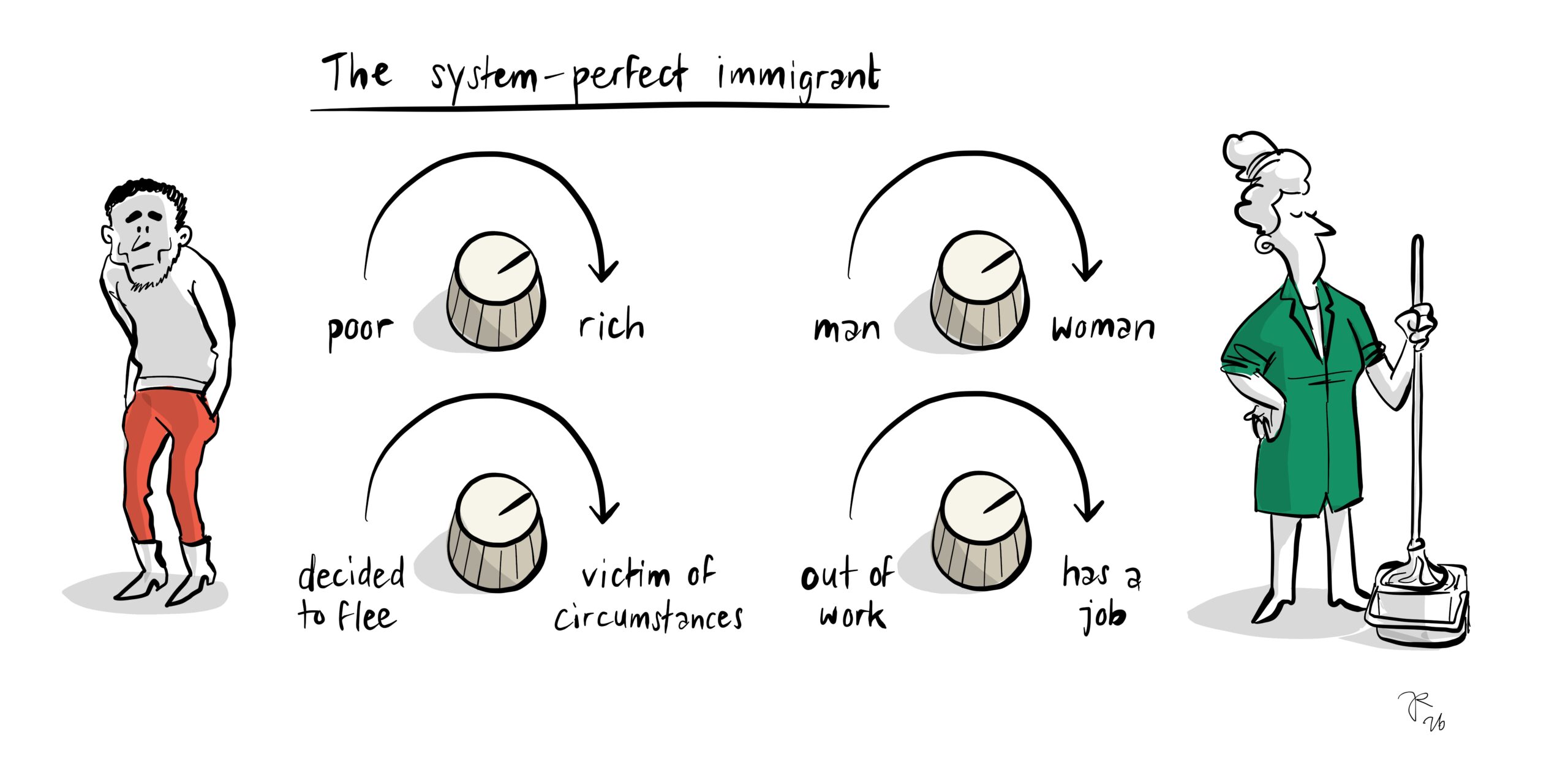
Illustration: Jonas Raeber
Mara Junge is a Research Associate at the German Centre for Integration and Migration Research (DeZIM) in Berlin and at the University of Bremen’s Research Center on Global Dynamics of Social Policy.
References:
–Barglowski, K., & Bonfert, L. (2023). Migrant organisations, belonging and social protection: The role of migrant organisations in migrants’ social risk averting strategies. International Migration, 61(4), 72–87.
–Borrelli, L. M., Kurt, S., Achermann, C., & Pfirter, L. (2021). (Un)conditional welfare? Tensions between welfare rights and migration control in Swiss case law. Swiss Journal of Sociology, 47(1), 93–114.
–Bruzelius, C. (2020). Non-for-profits and EU citizens’ cross-border social rights in different welfare states. Journal of Social Policy, 49(3), 601–621.
–Demetriou, D. (2018). Welfare restrictions and ‘benefit tourists’: Representations and evaluations of EU migrants in the UK. Communications, 43(3), 379–401.
–Dickson, E., & Rosen, R. (2021). ‘Punishing those who do the wrong thing’: Enforcing destitution and debt through the UK’s family migration rules. Critical Social Policy, 41(4), 545–565.
–Gago, A. (2024). Social policies as a tool of migration control: The case of Switzerland. Sozialpolitik.ch, 1(2024, June).
–Henninger, J., & Römer, F. (2021). Choose your battles: How civil society organisations choose contest-specific goals and activities to fight for immigrant welfare rights in Malaysia and Argentina. Social Policy & Administration, 55(6), 1112–1128.
–Henninger, J., Junge, M., Römer, F., & Bartsch, S. (2025, March). The Immigrant Social Rights Data Set (ImmigSR) (2nd updated edition, as of 04.03.2025) [Technical report].
–Junge, M. (2025). Behind and beyond closed doors: Understanding civil society strategies in immigrant social rights advocacy. Journal of European Social Policy, 0(0).
–Mengesha, Z., Alloun, E., Weber, D., Smith, M., & Harris, P. (2022). “Lived the pandemic twice”: A scoping review of the unequal impact of the COVID-19 pandemic on asylum seekers and undocumented migrants. International Journal of Environmental Research and Public Health, 19(11), Article 6624.
–Römer, F., Henninger, J., & Harris, E. (2024). Social protection for mobile populations? A global perspective on immigrant social rights. Social Policy & Administration, 58(1), 155–174.
–Ullah, A. A., Nawaz, F., & Chattoraj, D. (2021). Locked up under lockdown: The COVID-19 pandemic and the migrant population. Social Sciences & Humanities Open, 3(1), 100126.
–Van Oorschot, W. (2006). Making the difference in social Europe: Deservingness perceptions among citizens of European welfare states. Journal of European Social Policy, 16(1), 23–42.
