

When Equal Rights Do Not Lead to Equal Treatment of Mobile EU Workers
Freedom of movement is a cornerstone of European integration. EU citizens have the right to live and work in other member states and, in principle, should receive equal treatment when accessing public services. Yet in practice, this does not only depend on everyday interactions with public administrations but, as our study shows, also on the broader political reception context. Individual decisions in citizen-bureaucrat encounters can lead to different outcomes for different people, potentially resulting in unequal treatment.
Whether mobile EU citizens are treated equally depends, besides bureaucratic discretion, also on the broader political reception context of a country. This includes the broader policy environment and public attitudes toward migrants and mobile individuals within Europe.
To explore this, we conducted a large survey in Denmark, Ireland, Spain, and Switzerland. The data were collected in early 2024 from 10,298 participants, including members of the public and 2,403 public administration officials.
Participants were asked to imagine working in a local government office and receiving two requests from EU citizens about their eligibility for unemployment benefits. Because the conditions for accessing this benefit are complex, a detailed response would be especially helpful. However, they were told they only had time to provide a personalized answer to one of the two requests, while the other would receive a standard reply. They therefore had to decide who would receive more personalized assistance.
Each applicant profile varied randomly across several characteristics: nationality (French or Bulgarian), language proficiency in the host-country language, gender, age, profession, length of stay in the country, and recent job-search activity. Each participant evaluated ten pairs of applicants, allowing us to identify whether particular characteristics influence who receives more personalized assistance.
Mobile EU citizens are a particularly revealing case for studying discrimination. Because they have the same legal status and are generally viewed more favorably than migrants from outside the EU, any differences in how they are treated would reveal a gap between equal rights on paper and how these rights are applied in practice.
How National Reception Context Shapes Unequal Treatment
One way to capture differences in national reception contexts is through national immigrant integration policies, as measured by the Migrant Integration Policy Index (MIPEX). According to this index, Denmark and Switzerland have less favorable integration policy regimes, while Ireland and Spain have more favorable ones.
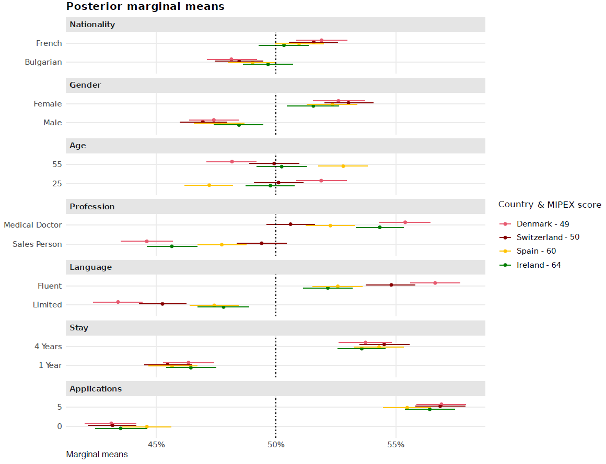
Differences in how mobile EU citizens are treated across countries are indeed linked to the broader political reception context. The experiment reveals that discrimination based on cultural markers—particularly nationality and language proficiency—varies across these countries (see Figure 1). In Denmark and Switzerland, preferential treatment based on nationality and language skills is most pronounced. Applicants from culturally closer countries and those who speak the host-country language fluently are more likely to receive personalized assistance. In Ireland and Spain, by contrast, these differences are smaller.
Figure 1. How different characteristics such as nationality, language skills, and length of stay, influence the chances of receiving personalized assistance across four countries.
Source: Manatschal et al. (2026, p.8).
At the same time, the strongest differences in treatment are linked to indicators of individual effort rather than nationality. Across all four countries, applicants who demonstrate stronger efforts to integrate—such as longer residence, more job applications, or stronger language skills—are consistently more likely to receive personalized assistance (see Figure 1). While language skills can signal cultural difference, like nationality, they can also be seen as a sign of an individual’s effort to integrate into the host society.
Public Officials and Citizens Behave in Similar Ways
Another central question is whether public officials behave differently from the general public when evaluating such requests. Public officials are often expected to apply rules more neutrally because of professional norms and institutional constraints. In practice, however, public officials and members of the public behave in very similar ways.
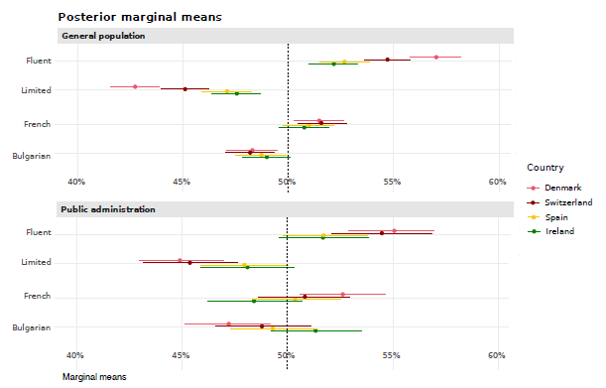
Across the four countries, both groups tend to favor culturally closer applicants and those with fluent language skills (see Figure 2). This similarity indicates that decision-making by public officials reflects broader societal attitudes rather than their professional role alone.
Figure 2. How language skills and nationality influence who is more likely to receive personalized assistance, across countries and between the general public and public officials.
Source: Manatschal et al. (2026, p.12).
At the same time, the tendency to treat some mobile EU citizens in a preferential manner based on cultural markers—which can be described as the “migrantization” of mobile EU citizens—is somewhat weaker among public officials than among the general population. Nevertheless, the overall patterns remain very similar across both groups.
A consistent pattern emerges across the four countries studied. Signs of effort—such as job search activity, language skills, and longer residence—play a major role in shaping who receives personalized assistance. At the same time, nationality and language also matter, particularly in countries with less favorable integration policies. Further analyses show that not only integration policies, but also individual attitudes towards migrants and mobile individuals can alter this tendency to “migrantize” mobile EU citizens. Even in the context of EU free movement, where citizens formally share equal rights, the way requests are evaluated can vary depending on the country, the person evaluating the request, and the characteristics of the applicants.
Valon Hasanaj is a political economist whose research and teaching focus on welfare state policy, economic inequality, and discrimination.
Anita Manatschal is a political scientist whose research focuses on migration policy, public opinion on migration, political behavior and discrimination and project leader of the nccr – on the move.
Reference:
–Manatschal, Anita, Valon Hasanaj, Didier Ruedin, and Lisa Marie Borrelli. 2026. « Migrantization of mobile EU citizens? Assessing the impact of political reception contexts on bureaucratic discrimination. » Comparative Migration Studies.
