

Challenging Crisis Narratives: Migrant Voices of the COVID-19 Pandemic

Crises are often understood as moments of urgency and disruption that require fast decisions and can have far-reaching consequences for our social systems in both the short and long term. Yet, they are not experienced in the same way by everyone. The COVID-19 pandemic revealed how different these experiences can be, and how moments of crisis can bring existing vulnerabilities into sharper focus.
Labor migrants working in Switzerland often face precarious conditions in both their professional and everyday lives (Alberti, 2014; Robinson et al., 2019). The COVID-19 pandemic further affected these conditions, shaping how labor migrants were able to work, move, and cope with additional uncertainties (Birke & Neuhauser, 2023). At the same time, the uncertainties caused by the pandemic made existing forms of vulnerability and precarity even more visible.
Narratives of Crises: Increased Precarity
To better understand who was most affected by the health crisis, I spoke with experts working in legal counseling and integration services, spiritual counseling, trade unions, and employers’ associations. These conversations quickly highlighted the hospitality and catering industry as a key area of concern, as it was severely affected by prolonged closures and mobility restrictions during the pandemic.
Together, these insights point to a clear intensification of precarious conditions for migrant workers during the COVID-19 pandemic, particularly in three areas:
- Job security and working conditions: Uncertainty about work activity and terms due to frequently changing regulations, as well as increased insecurity regarding employee rights, such as vacation days.
- Wages: Uncertainty about income entitlements during lockdowns, wage reductions linked to short-time work schemes (typically 80 percent of the regular salary), and unclear procedures for wage compensation.
- Mobility: Uncertainty about the possibility of entering or re-entering Switzerland.
These conclusions are also reflected in the experiences of the 29 migrant workers employed in the hospitality and catering industry in Valais and Grisons who were interviewed for this study.
For instance, Tiago,* a 36-year-old waiter who has worked in Switzerland during peak seasons since 2018 and spends the off-season in Portugal, described the uncertainty he faced:
“My contract at Hotel [A] ended on March 31, and I was supposed to start at Hotel [B] on April 1. When the pandemic broke out, I was in Portugal, enjoying the last days of my vacation, when they called me and told me that everything had shut down. […] I didn’t know whether my contract was active or not. I was still in my probationary period. They could have let me go at any moment. […] Later on, I was informed that my contract would be continued and that I would be paid 80 percent of my salary.”
Alongside job insecurity, wage reductions, and restricted mobility, participants also reported several additional challenges:
- deterioration of employment contracts, such as a change from seasonal contracts to hourly wages,
- heightened fear of job loss,
- longer and more intense working days due to staff shortages,
- increased physical strain linked to mask-wearing, and
- a decline in workplace atmosphere and relationships with colleagues and guests, linked to tensions around polarized reactions to COVID-19 measures.
Taken together, these accounts suggest that the pandemic further intensified precarity among migrants working in Switzerland’s hospitality and catering industry.
Varied Narratives: Wages
At the same time, interviews also revealed narratives that nuance this interpretation. One notable example concerns wage reductions.
Some participants explained that reduced income made little difference to them, as expenses were also lower during lockdowns. Julio, a 41-year-old sous chef from Costa Rica, recalled: “For me, it was the same, as I didn’t have the opportunity to spend my money then.”
Others noted that although the pandemic did not cause major financial hardship, it did require adjustment. Sofia, a 36-year-old receptionist from Spain, reflected: “I don’t remember having any problems. […] But still, I’m aware that this was a difficult time financially. Because you had to adapt, and that’s not always easy.” This type of narrative was more common among well-educated migrants and workers who did not remain in Switzerland during the off-season or lockdown periods.
However, some participants did experience the financial consequences of the crisis. Faced with temporary income uncertainty, they decided to apply for unemployment benefits during the off-season, in some cases for the first time, as was the case with Francisca (see this blog post). Yet, participants did not report seeking other forms of financial support, such as assistance from church organizations, family members, or meal vouchers.
These accounts demonstrate that the crisis was not experienced in a uniform way.
Counter-Narratives: Time
Another recurrent theme in the interviews was the value of newly gained time. In a sector marked by long working hours and no opportunities to take leave during high seasons, for example, to attend important family events, reduced hours were often experienced positively.
Julio recalled: “For me, it was like working in an office. I started every day at 8:30 or 9:00 in the morning and finished at 5:30 or 6:00 in the evening. That was perfect for me. It was a really great schedule.”
For others, shorter working days offered much-needed relief. Rabela, a 46-year-old Portuguese housekeeper, noted: “It was actually good for me because there wasn’t as much work as before. My knee had time to recover a bit, and things were quieter. We worked every day, just fewer hours.”
Maria, a 44-year-old service worker from Argentina, emphasized how the additional time helped her family reconnect after a difficult period: “This time together during the pandemic has helped rebuild my relationship with my husband because we had time for ourselves.”
The narratives underscore how long and, as described by Alberti (2014), “anti-social” working hours affect not only workers’ health but also their family lives, highlighting challenges that persist well before and beyond times of crises.
Challenging COVID-19 Crisis Narratives
The COVID-19 pandemic exacerbated existing precarities for migrant workers in Switzerland’s hospitality and catering industry. Employment contracts, working conditions, workplace atmosphere, job security, physical strain, and mobility were all affected. However, these findings do not point to a single or lasting experience of increased precarity, challenging one-dimensional portrayals of the pandemic as purely negative.
Importantly, the narratives collected also shed light on working conditions during the so-called “normal” times, particularly in relation to long working hours and limited time for family life, as explained by Rabela and Maria. Crisis narratives and counter-narratives can therefore not only reveal how these moments of urgency and disruption are lived and perceived, but also help us better understand the everyday challenges that often remain less visible outside times of crises.
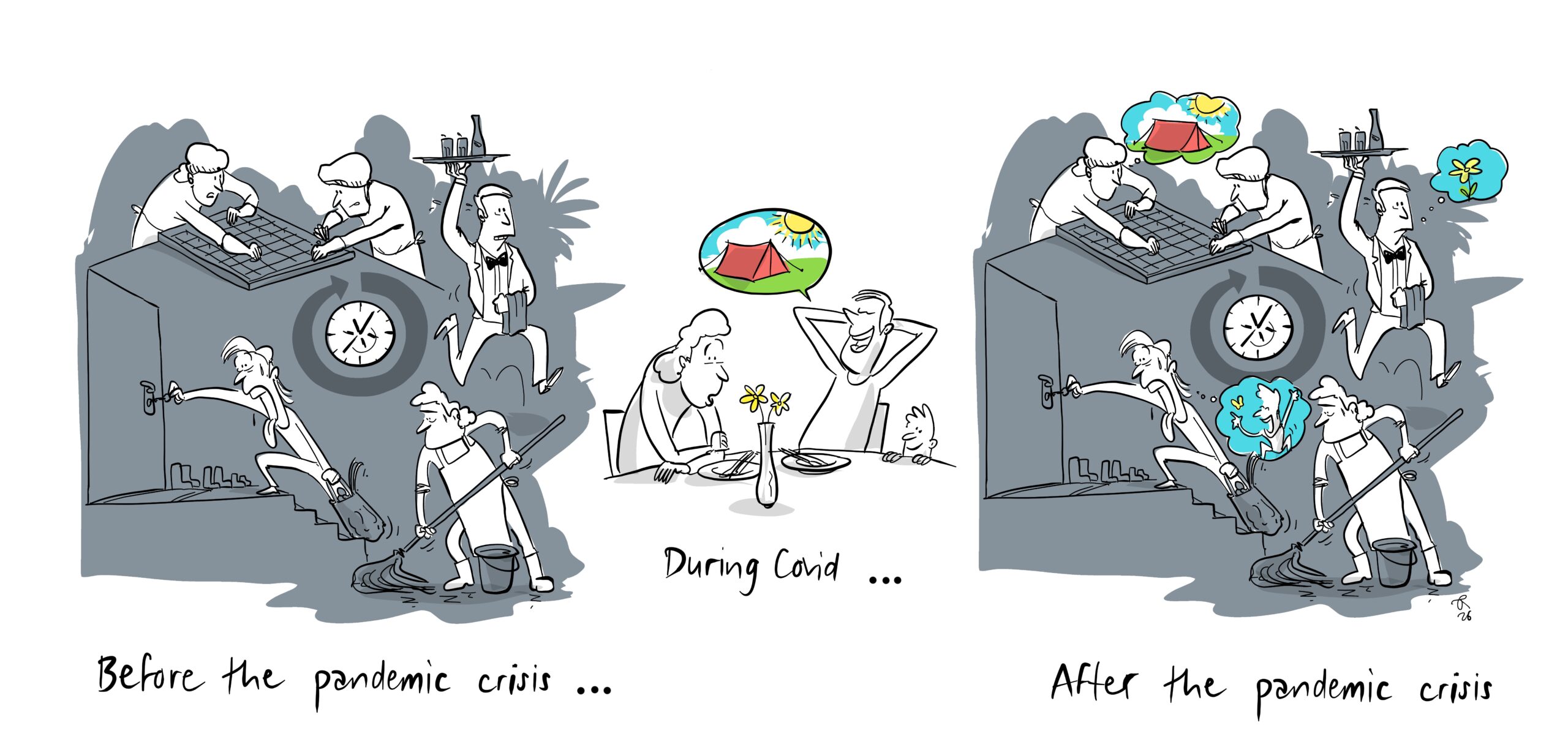
Illustration: Jonas Raeber
*For identity protection, the names of participants were anonymized.
Livia Tomás is a Postdoctoral Researcher at the ZHAW of Social Work. In the framework of the project “Evolving (Im)Mobility Regimes,” she studies the living and working conditions of migrants in the Swiss hospitality industry and examines how the COVID-19 pandemic has influenced these conditions.
References:
–Alberti, G. (2014). Mobility strategies, ‘mobility differentials’ and ‘transnational exit’: the experiences of precarious migrants in London’s hospitality jobs. Work, employment and society, 28(6), 865-881.
–Birke, P., & Neuhauser, J. (2023). Migration und Prekarität in der Pandemie: Empirische Studien aus Deutschland und Österreich. Arbeit 32(1), 3-26.
–Koselleck, R., & Richter, M. (2006). Crisis. Journal of the History of Ideas 67(2), 357-400.
–Meyer, F. (2012). Analyzing the Subjectivity of ‘Crisis’: Local Practices between Circularity and Discourse Theory. In E. Kapferer, A. Koch, & C. Sedmak (Eds.), The Logics of Change: Poverty, Place, Identity and Social Transformation Mechanisms (pp. 269-295). Cambridge Scholars Publishing.
–Robinson, R., Martins, A., Solnet, D., & Baum, T. (2019). Sustaining precarity: critically examining tourism and employment. Journal of Sustainable Tourism, 27(7), 1008-1025.
–Walby, S. (2015). Crisis. Polity.
