

Between Support and Fear: Civil Society at the Margins of Social Assistance

When people turn to organizations like Caritas, they are often looking for clarity and support in difficult situations. Since a Swiss migration law change in 2019, civil society organizations have operated in a narrow space: they cannot replace the welfare state or fully remove legal uncertainty. What they can do is respond — accompanying, advocating, and supporting access to social rights they cannot guarantee.
For years, debates about immigration and welfare have been shaped by fears of so-called “welfare tourism.” This narrative frames immigrants as people who relocate to misuse social benefits. It was particularly promoted by the established far-right Swiss People’s Party in their 2014 „Mass Immigration Initiative,“ despite consistent evidence to the contrary.
It was in this political climate that the 2019 reform of the Foreign Nationals and Integration Act (FNIA) was implemented. Under the reform, Swiss social assistance offices are required to inform migration services when non-citizens receive welfare support. In practice, this means that asking for social assistance can put a person’s residence permit at risk, potentially leading to downgrading or even permit withdrawal.
Since its introduction, the reform and its consequences have remained highly contested.
When People Avoid Their Social Rights: Non-Take-Up
Shortly after the reform came into effect, the COVID-19 pandemic reached Switzerland in early 2020. During the lockdowns, many people were surprised to see long queues outside food banks across the country. What this made visible, however, was not new. Researchers had warned that fear of losing a residence permit was already discouraging many migrants from applying for social assistance. The pandemic brought this hidden problem into the spotlight.
Avoiding social assistance despite being eligible is a widespread and persistent issue across many countries. It raises questions about how accessible and adequate welfare systems are. The concept is straightforward: when policies make it simpler and safer to apply for benefits, people tend to take them up. Conversely, when reforms introduce uncertainty or fear, people are more likely to stay away from social assistance and remain in precarious situations.
The FNIA 2019 reform emerged within the classic welfare chauvinist narrative that the welfare state should be protected „against the burden imposed by immigrants […]“ (Careja & Harris, 2022). Seen from this perspective, could an increase in social assistance avoidance be interpreted as the reform’s success in its exclusionary intent?
Civil Society: Mediating Rights They Cannot Guarantee
Against this backdrop, our research on “Poverty and Social Security in Times of Crisis” investigates how civil society organizations (CSOs) navigate such environments. Since the reform, registrations by non-EU and non-EFTA citizens at a Caritas office have roughly tripled. One social worker from this office shared:
„This threatening letter – in quotation marks – informs them that if they continue to receive social assistance, it could have an impact. And first, this letter arrived extremely quickly and was, of course, written in such a way that it could trigger fear. And then second, yes, we had no choice but to say again: ´No, you have to register.`“
Civil society organizations do not have the resources or the authority to replace the state’s responsibility for providing social assistance. At best, they can offer limited and short-term support, if at all. Yet the consequences of missing support in situations of poverty can be long-lasting and difficult to reverse.
This creates a dilemma for social workers, who often find themselves caught in between. They are asked to support people in accessing their social rights. Caritas social workers highlight how challenging it is to encourage people to apply for social assistance when doing so may put their residence status at risk. The underlying tension between access to welfare and risk of exclusion remains unresolved.
As poverty became more visible during COVID-19, the public debate around the reform started to substantially shift. Real-life experiences made the consequences of the policy harder to ignore.
In response, 80 specialized civil society organizations formed an alliance to highlight the problems created by the reform, and 15,000 people signed their petition, „Poverty Is Not a Crime.“
Research in social work, law, and migration further documented these underlying dynamics, and the Federal Commission on Migration dedicated an entire issue of its magazine to the topic. In 2023, both chambers of the Swiss parliament agreed that the regulation should be revised.
However, despite these efforts, the changes have not yet led to concrete policy reform.
Who Are the Specialists?
Whose expertise counts when designing policies that affect marginalized populations?
This question emerged during the recent public consultation on proposed changes to the law. The proposed amendment sought to protect people whose poverty is linked to structural factors rather than personal fault. Alongside political parties and cantonal authorities, 44 specialized civil society organisations submitted written responses.
Forty-three out of these 44, including the Swiss Red Cross, HEKS, and Caritas, supported the proposed changes. Yet, the responsible commission concluded there was no need for policy change, illustrating how the practice-based expertise of civil society organizations may be heard but ultimately not fully taken into account.
Meanwhile, governments, institutions, and researchers continue to seek explanations for why many people avoid asking for social assistance in the first place.
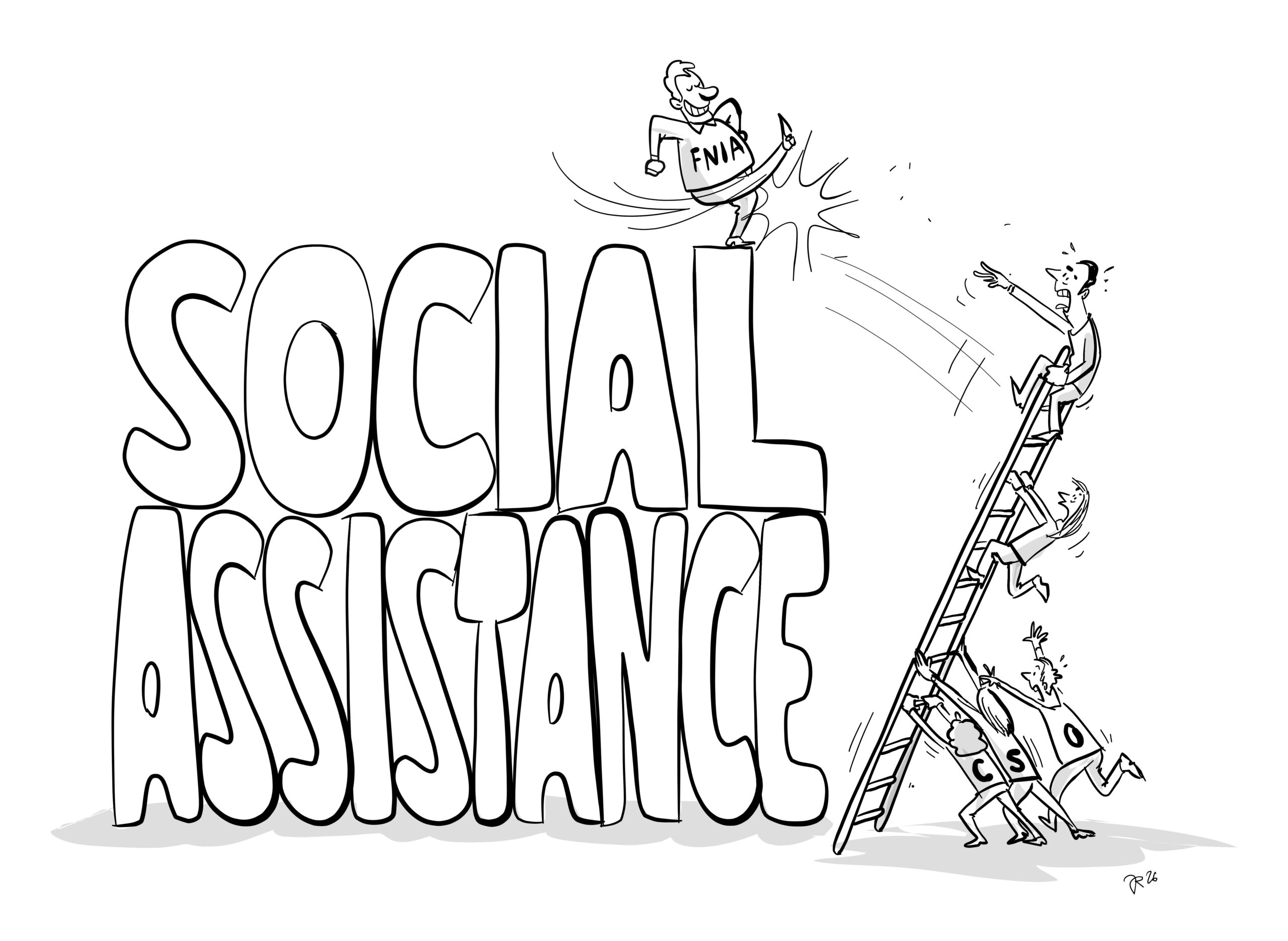
Illustration: Jonas Raeber
Rulla Sutter examines social inequality, the roles of CSOs in poverty reduction, and the digitalization of social work as a research associate at the Bern University of Applied Sciences in Social Work and as a PhD candidate at the University of Neuchâtel.
References:
–Borrelli, Lisa Marie. “Ignorance As Political Instrument? Integration Discourses on Migrant Welfare Recipients in Switzerland.” Geopolitics 30, no. 3 (2025): 1150–72.
–Careja, Romana, and Eloisa Harris. “Thirty Years of Welfare Chauvinism Research: Findings and Challenges.” Journal of European Social Policy 32, no. 2 (2022): 212–24.
–Ferwerda, Jeremy, Moritz Marbach, and Dominik Hangartner. “Do Immigrants Move to Welfare? Subnational Evidence from Switzerland.” American Journal of Political Science 68, no. 3 (2024): 874–90.
–Gago, Angie, Juliana Chueri, and Mia Gandenberger. “Welfare Chauvinism among Voters and Political Parties: Exploring Preferences for Restricting EU Migrants’ Access to Social Assistance in Switzerland.” Swiss Political Science Review n/a, no. n/a (2025).
–Lucas, Barbara, Jean-Michel Bonvin, and Oliver Hümbelin. “The Non-Take-Up of Health and Social Benefits: What Implications for Social Citizenship?” Swiss Journal of Sociology 47, no. 2 (2021): 161–80.
