

How Student Mobility is Changing in a Multipolar World

Every year, millions of students leave their homes to study abroad, but where they go is changing. While most still head to well-known higher education destinations such as North America, Europe, or Australia, over the past two decades, new academic centers have emerged in places like China, Malaysia or South Africa. Oriented more towards South-South circuits, these regional education hubs are helping to redesign the global map of international student mobility.
International student mobility takes two main forms: credit mobility and degree mobility. These differ in their goals, duration, and outcomes. Credit mobility involves temporary study periods abroad (usually lasting one semester or one academic year), during which students earn transferable credits while remaining enrolled in their home institution (Pozniak et al., 2025). Programs such as Erasmus+ in Europe exemplify this type of mobility, which focuses on learning experiences rather than the delivery of a foreign degree.
In contrast, degree mobility involves the full pursuit of a degree in a host country, usually for an entire bachelor’s, master’s, or PhD program. In this case, students obtain a degree from a foreign institution, reflecting a longer-term academic commitment that may influence their academic or professional trajectories.
Significant, Stable, yet Limited Growth
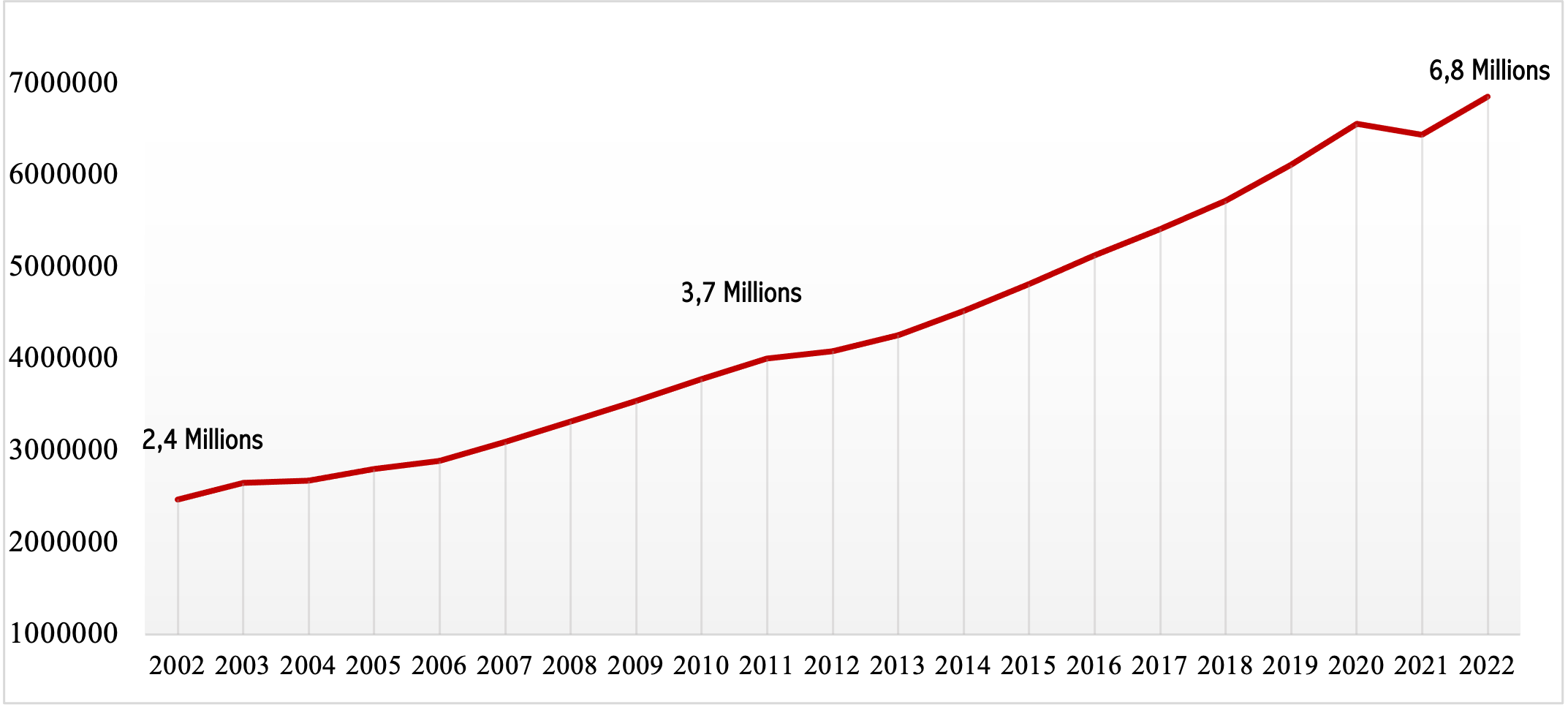
The global race to attract international students is undoubtedly one of the most significant dimensions of the internationalization of higher education and the competition between its various actors. Since the early 2000s, the number of students enrolled in post-secondary institutions outside their countries of origin has nearly tripled, rising from 2.4 million in 2002 to 6.8 million in 2022.
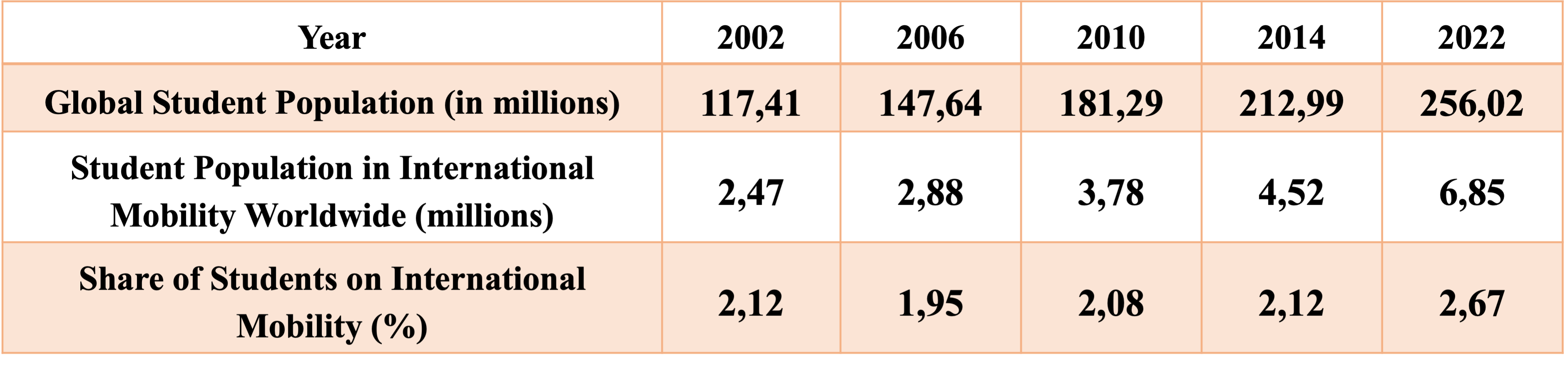
At this pace, forecasts estimate that the number of international students could reach 12 million by 2030 (Glass & Cruz, 2023). However, despite this impressive rise in absolute numbers, the share of mobile students within the total student population has barely changed over the past two decades, limited to around 2% only.
Graph 1: Evolution of the Number of International Students in the World
 Source: UNESCO Institute for Statistics (UIS), data extracted by the author on January 6, 2025.
Table 1: Number of Students Enrolled in Higher Education (2002-2022)
 Source: UNESCO Institute for Statistics (UIS), data extracted by the author on January 6, 2025.
While these numbers may seem impressive, they do not necessarily mean that a greater share of young adults are studying abroad. In fact, this increase merely mirrors the overall expansion of higher education worldwide. Such evidence challenges the dominant discourse on the internationalization of higher education and the tendency of reports to emphasize absolute numbers rather than relative mobility rates.
Moreover, most students do not travel that far to study. According to Campus France (2024), 90% of European students study within Europe, 58% of students from the Americas stay in their region, and 32% of those from Asia–Oceania do the same. In short, although international student mobility continues to grow, it still concerns only a small minority. Barely three people out of every one hundred students worldwide study abroad.
Inequalities and Hierarchies of Mobility
This limited share reflects the broader inequalities between regions of the world and remains subject to imbalances between supply and demand for higher education in the countries of origin and destination of the students. It also highlights the selectively social nature of international student mobility, which, beyond limited access to spatial mobility, contributes to the production and reproduction of social inequalities (Bilecen & Van Mol, 2017).
Indeed, while studying abroad is often considered a pathway to social advancement, in some cases it can fail to achieve this promise, leading to a form of social immobility or even social downgrading (Bréant, 2016). One possible explanation for this “disillusionment” lies in the significance and value of the places where the degree was obtained (Netz et al., 2024).
Today, it is no longer just obtaining an international degree that ensures a possible social advancement, but also the prestige of the institution that delivers it, and the reputation of the country where the degree was obtained. Degrees obtained from prestigious institutions located in economically and culturally influential countries are often highly valued.
In contrast, degrees obtained from institutions with less prestige or located in countries considered less developed tend to be viewed as less legitimate, even though the quality of education may be comparable. This hierarchization of international degrees and the places where they are obtained is closely linked to the construction and circulation of “geographical imaginaries” (Saïd, 1978) that structure the relations of power and domination between nations.
Moreover, international student mobility today is indissociable from policies aimed at controlling migration flows. Indeed, students wishing to pursue their studies abroad face increasingly strict administrative controls and, in several destination countries, encounter higher tuition fees than those applied to national students (Jamid et al., 2020).
This financial selection process primarily aims to attract students from wealthy backgrounds who are able to pay higher tuition fees and cover the cost of living in the host country. It also serves as a control mechanism, restricting candidates seen as “fake students” (Jamid, 2024), that is, migrants who use studying as a pretext to enter the country for other purposes. As a result, it reinforces social inequalities by excluding students from modest backgrounds and favoring those whose economic resources meet institutional and migration policy requirements.
South-South Mobility: A Geographical Turning Point
One of the often-overlooked realities of international student mobility is the growing multipolarity of this phenomenon (Glass & Cruz, 2023), and the continuing diversification of the geographical areas that attract students, reinforced by the emergence of new regional education hubs (Knight, 2010) in what are now known as the countries of the global South.
Indeed, an increasing number of countries in the global South, such as China, Malaysia, Singapore, Turkey, Qatar, and South Africa, have invested in the development of their universities, often in partnership with global institutions. As a result, they have created competitive and attractive higher-education systems that attract a growing number of students (Gunter & Raghuram, 2018).
These new destinations are no longer seen merely as alternatives to countries in the global North, but as full-fledged actors in the production and dissemination of knowledge. Behind these developments lies a deeper change: old geopolitical hierarchies of education and knowledge are being redefined, and the ways elites are formed are becoming more diverse and complex than ever before.
The rise of educational hubs in countries in the global South is changing how people perceive quality and opportunity. For many students from developing countries, they offer programs that are not only more financially accessible, but also better aligned with their needs for economic and social development. This “South-South” mobility is also at the heart of a wider political, economic, and educational soft power strategy. Countries in the global South like China, are using education partnerships, especially in Africa, to strengthen their regional and international influence and position themselves as key actors in global education.
My current postdoctoral research at the University of Neuchâtel examines these emerging dynamics through the case studies of Senegal and Morocco. Understanding how new education hubs develop in the global South helps us see how knowledge and influence are being redistributed in an increasingly multipolar world.
Hicham Jamid is a postdoctoral researcher at the Laboratory for the Study of Social Processes at the University of Neuchâtel, and an affiliated researcher of the nccr – on the move.
References:
–Bilecen, B., & Van Mol, C. (2017). Introduction: international academic mobility and inequalities. Journal of Ethnic and Migration Studies, 43(8), 1241–1255.
–Bréant, H., (2016). Les chemins internationaux de la mobilité sociale : expériences de mobilité et d’immobilité sociale dans les parcours migratoires comparés d’émigrés comoriens et togolais, Thèse de Sciences Politiques, Université Paris 1.
–Campus France, Chiffres clés, 2024.
–Glass, C. R., Cruz, N. I. (2023). Moving towards multipolarity: Shifts in the core-periphery structure of international student mobility and world rankings (2000–2019). Higher Education, 85(2), 415-435.
–Gunter, A., Raghuram, P. (2017). International study in the global south: linking institutional, staff, student and knowledge mobilities. Globalisation, Societies and Education, 16(2), 192–207.
–Jamid, H. (2024), Loi immigration : la « caution retour » ou l’obsession du « faux » étudiant étranger. The Conversation.
–Jamid, H., Kabbanji, L., Levatino, A. et Mary, K. (2020). Les migrations pour études au prisme des mobilités sociales. Migrations Société, 180(2), 19-35.
–Knight, J. (2010). Higher education crossing borders: Programs and providers on the move. In Higher education in a global society. Edward Elgar Publishing.
–Netz, N., Van Mol, C., Riaño, Y., & Raghuram, P. (2025). The role of place in international student mobility. Globalisation, societies and education, 23(4), 825-835.
–Pozniak, L., Cultrera, L., Vermeylen, G. (2025). International student mobility: the key to securing the first job in a globalized world. Discover Global Society, 3(1), 88.
–Saïd, E-W., (1978). Orientalism. New York: Pantheon Books.
