
Counter-Narratives of Crisis: What Frontline Actors Learned from COVID-19

The COVID-19 pandemic intensified existing precarities and created new ones. While some people received state support, many others, especially those with fragile living and working conditions, fell through the cracks. NGOs and civil society initiatives tried to step in to fill those gaps. But what did that mean?
During the pandemic, frontline organizations—such as charities, soup kitchens, emergency shelters, and food distribution services—faced a wide range of challenges. Lockdowns and the closure of nonessential businesses affected people in precarious living and working conditions particularly hard, including low-income workers, undocumented migrants, and sex workers.
This was especially true for undocumented migrant workers, but also for migrants with legal status who avoided social assistance for fear of jeopardizing their residence permits (see Sutter in this blog series).
Alongside efforts to mitigate these precarious situations—such as providing direct financial aid—frontline actors had to implement health measures, protect their teams, reorganize daily operations, and deal with major uncertainties. This led to a considerable increase in workload and emotional pressure.
Paradoxically, the crisis also created new opportunities. Donors, foundations, and local authorities provided exceptional financial support, even to organizations assisting undocumented migrants. Many described this as a “wave of solidarity.”
Administrative procedures were simplified. Decisions were made faster, and emergency aid came with fewer controls, giving organizations more flexibility. Yet these developments were mixed. While access to funding became easier, frontline organizations were also pushed further into the role of primary crisis responders.
Who Was Seen as Deserving? Shifting Lines of Inclusion and Exclusion
As precarities deepened, asking for help became more socially accepted. One interviewee described this as a “universality of vulnerability,” when it became clearer that many people, not only traditionally marginalized groups, could suddenly find themselves in need of support.
Because many individuals were victims of circumstances rather than responsible for their economic difficulties, perceptions of who deserved support also changed. In some cases, this led to additional funding for organizations supporting undocumented migrants, support they had not received before the pandemic.
The increased autonomy gained during the pandemic also enabled some organizations to redesign their services. For example, they introduced simplified online forms for financial aid or expanded access to 24-hour emergency shelters. At the same time, these changes created new barriers. Digital tools were not accessible to everyone, and maintaining quality standards became more difficult. Furthermore, due to a lack of space, beneficiaries had to be prioritized in some cases. Thus, new forms of inclusion emerged alongside new forms of exclusion.
Who Is Responsible in Times of Crisis?
Debates about vulnerability and deservingness also raised broader questions: Who is responsible for supporting vulnerable groups during a crisis? Frontline organizations were often positioned as “crisis responders,” highlighting long-standing tensions about the division of responsibilities between the (welfare) state and civil society.
Interviewees from various types of organizations—ranging from state-funded services to voluntary initiatives—reflected on the ambivalent role they played during the crisis. One frontline actor noted, “One cannot necessarily rely on the state to manage crises.” At the same time, they warned that frontline organizations risk making precarious situations invisible “because they handle precarity on the side.”
This tension becomes especially visible when looking at access to social assistance for undocumented migrants. Many cannot access public welfare systems and instead rely on non-state frontline organizations, which often apply more inclusive eligibility criteria.
This perspective challenges the widely praised agility of frontline organizations. While their ability to “fill the gaps” is publicly celebrated, some actors saw this more critically. In their view, it risks reinforcing broader trends in which responsibility for social support gradually shifts from the state to civil society, both during crises and in everyday frontline work.
Rethinking the “Crisis” Narrative
By reflecting on vulnerability, deservingness, and responsibility, frontline actors also challenged dominant crisis narratives. One interviewee noted:
“I’m realizing now, as I answer these questions, that [our NGO] isn’t always in crisis mode — but the need for support isn’t so different during a crisis than outside of one. That’s why I keep thinking: ‘What’s different? We always work like this…’ (…) The hardship we’re trying to address is there, whether there’s a crisis or not.”
For many frontline actors, “crisis” referred not only to sudden threats but to long-standing issues of inclusion, exclusion, and responsibility that existed long before the pandemic.
When the pandemic measures ended, many organizations felt a sense of relief. They could once again focus on what many considered core tasks, such as relational work and face-to-face counseling. Yet the idea of a “return to normal” was viewed critically. Many pointed out that crises existed long before COVID-19 and continue afterward. What changed was that everyday hardship became more visible to the broader public during the pandemic. As one frontline worker remembered:
“[During the pandemic] I felt hope that so many things could be different in our society. Suddenly, solidarity was no longer a dirty word. Even conservative politicians used the word and not just as a criticism, but simply because people looked out for each other, for example by going shopping for the elderly lady in the neighboring apartment.”
The pandemic did not create the challenges frontline organizations confront—it simply exposed them. It revealed the legal and social precarities many people already face, as well as how quickly responsibilities shift, how inclusion and exclusion are continually renegotiated, and how fragile public solidarity can be. Official crises may fade, but the claims for sustained, shared responsibility and long-term solidarity remain.
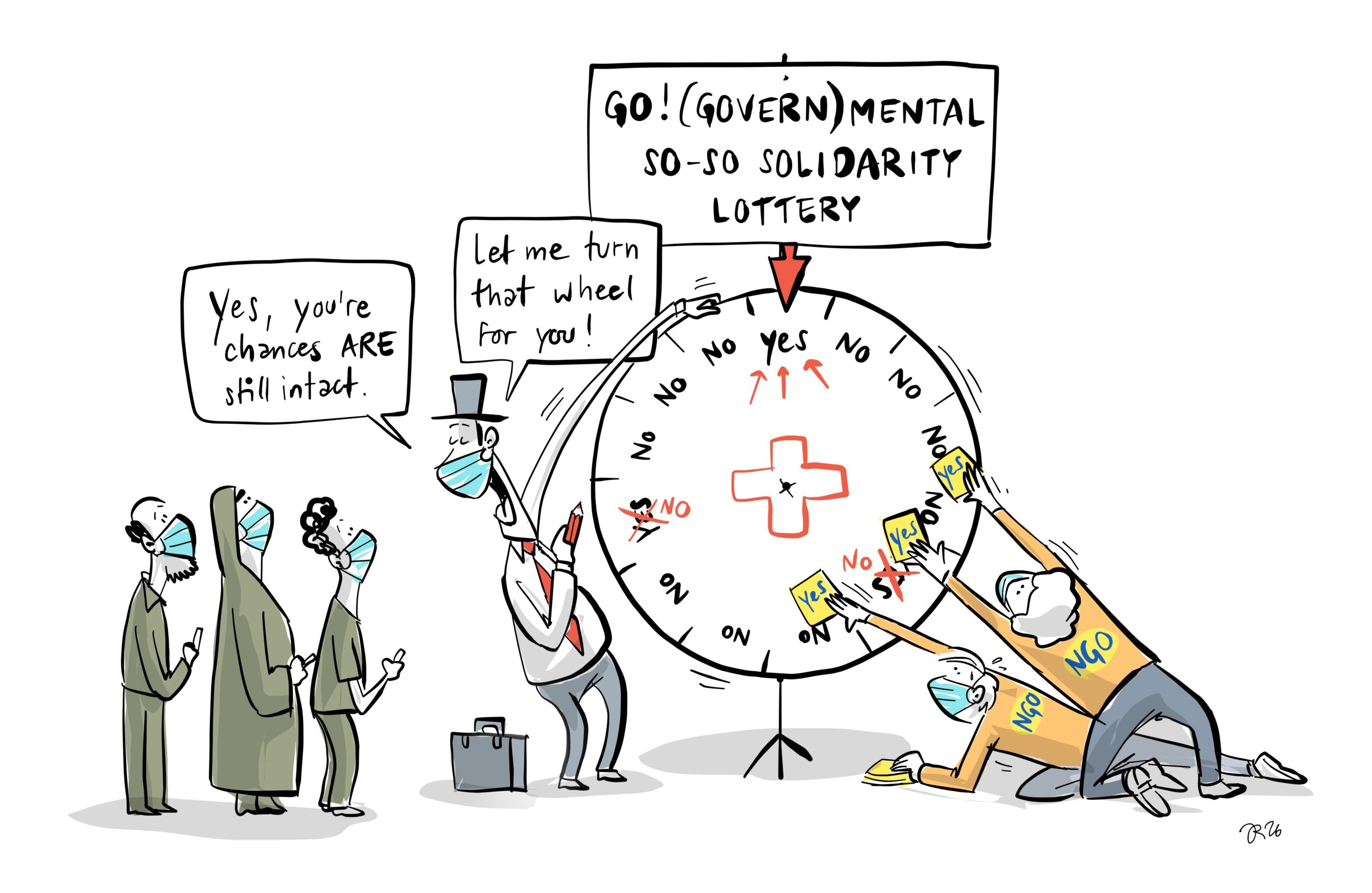
Illustration: Jonas Raeber
Andrea Friedli is a research associate at the University of Applied Sciences HES-SO Valais-Wallis and at the University of Fribourg.
Livia Schambron is a research assistant at the University of Applied Sciences and Arts Northwestern Switzerland FHNW, and a PhD candidate at the University of Bern.
References:
–Borrelli, L. and Kurt, S. (2024) Social services crisis management practices towards poor foreign nationals. Collection of Papers from the International Conference “Social Work and Social Policy in Times of Global Crises” 19 – 22 September 2023. Ohrid, 2024.
–Crabtree, D.I. and Wehde, W.W. (2023) Who deserves what and why during the COVID ‐19 pandemic: Applying the CARIN principles of deservingness to the American welfare state, Social Policy & Administration, 57(3).
–Gauttier, E., Mittmasser, Ch., Carbajal, M. and Chimienti M., (2025): Migrant Women in Times of Crisis: Vulnerability and Agency Among Domestic Workers. nccr – on the move blog Series “Vulnerabilization of migrant workers during crises.”
–Drilling, M., Tabin, J.-P., Lequet, M., Böhnel, M., Dittmann, J., Lepori, A., et al (2024) Becoming an advocate for the voiceless of a system. The impact of Swiss Solidarity’s financial support for frontline work organizations during the Covid-19 pandemic. Evaluation report.
–Haubner, T. and van Dyk, S. (2023) Die Verzivilgesellschaftlichung der sozialen Frage. Freiwillige und Hilfebedürftige im Strukturwandel des Wohlfahrtsstaats, in F. Kessl and H. Schoneville (eds) Die neue Mitleidsökonomie: Transformationen des Helfens.
–Kessl, F. and Schoneville, H. (2024) Mitleidsökonomie, Beltz Juventa.
